project · finished · Rust
nbody-sim
N-body gravity simulation with RK4 and parallel force calculation, checked against Kepler's laws.
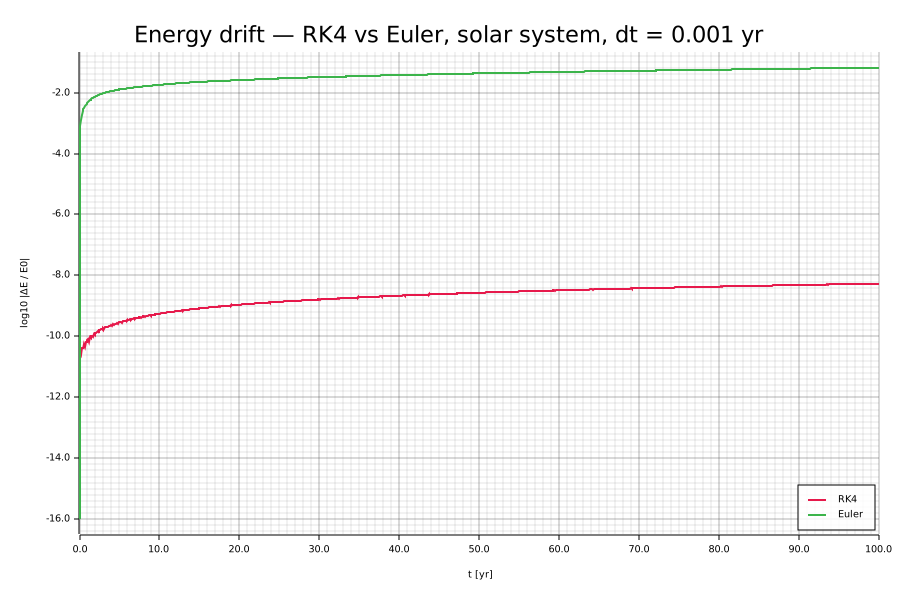
result RK4 energy drift of 5.4×10⁻⁹ over a 100-year solar-system run, against 6.5×10⁻² for Euler — seven orders of magnitude at the same time step.
source ↗ sabfodel/N-Body-Gravity-Simulation-Computational-Astrophysics
Written from scratch and finished in a day. The point was simple: see for myself what numerical integration gets wrong, and how badly.
What it does
Integrates the motion of bodies under mutual gravity, in units of AU, years and solar masses (so ):
- RK4 integrator, with Euler kept as a reference
- force evaluation, parallelised with Rayon
- Softening parameter to keep close encounters from blowing up
- Energy, momentum and angular momentum tracked at every snapshot
Results
Kepler validation. A two-body Sun–Earth system started at perihelion, compared against the analytical orbit:
| Parameter | Analytical | Simulation | Rel. error |
|---|---|---|---|
| Orbital period | 365.2495 days | 365.2683 days | 5.2×10⁻⁵ |
| Eccentricity | 0.01670 | 0.01670 | 2.9×10⁻¹¹ |
The period error comes from how finely perihelion passages are detected (half a time step), not from the integrator.
Energy drift. Full nine-body solar system, 100 years, yr:
| Integrator | Final |
|---|---|
| RK4 | 5.4×10⁻⁹ |
| Euler | 6.5×10⁻² |
Parallel speed-up. Rayon only pays off once is large enough to amortise the thread pool: 1.0× at , about 6× from upward on 16 logical cores.
What I learned
RK4 is accurate, but it isn’t symplectic. Its energy error is tiny over a century, but it still grows systematically rather than oscillating. That is exactly why long orbital runs use symplectic integrators — and the obvious next step for this code.
Softening isn’t a hack, it’s a modelling choice. When two bodies get arbitrarily close the force diverges and no step size saves you. The potential has to use the matching softened form, or stops being consistent with the force law.
Tests should check physics, not code paths. The suite checks Newton’s third law, conservation laws and Kepler’s third law — not just that functions return.
Limitations
- Fixed time step; close encounters would need adaptive stepping.
- forces — fine for a solar system, not for a galaxy (that needs Barnes–Hut).
- RK4 only; no symplectic integrator yet.