project · active · Rust
gargantua-rs
Ray tracer for light around a Schwarzschild black hole. No physics libraries.
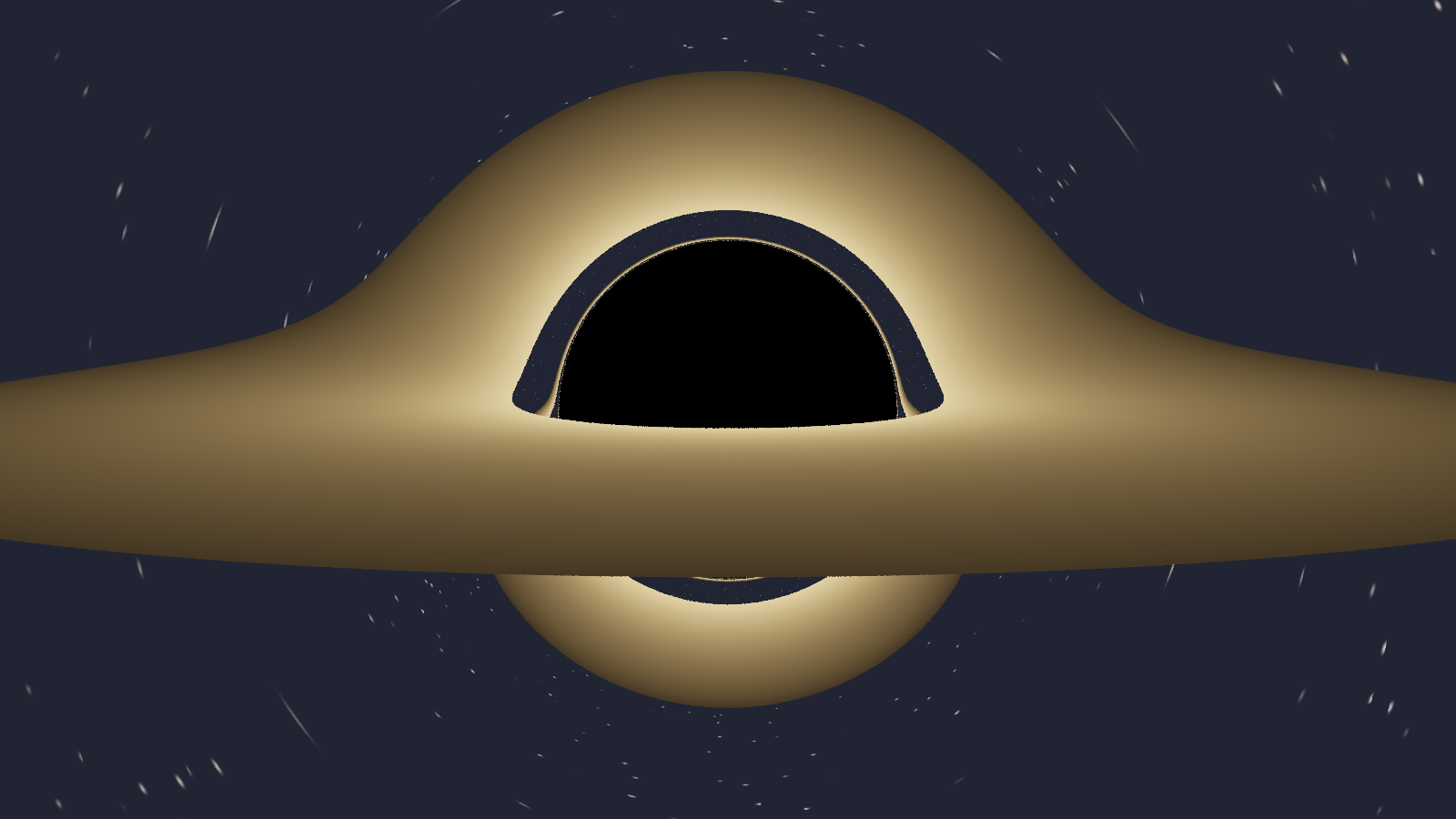
result Rays with impact parameter below b = (3√3/2) rₛ ≈ 2.598 rₛ are captured — the shadow size the theory predicts, checked in the test suite.
source ↗ sabfodel/gargantua-rs
I wanted to know how the image in Interstellar was computed, so I had a go at it myself.
The physics
Working in units with , the null geodesic equation of the Schwarzschild metric reduces to a single Newtonian-looking equation:
where is the conserved angular momentum. The term is pure spacetime curvature: it doubles Newton’s prediction for light bending and creates the photon sphere at , where light can orbit the hole.
What it does
Every pixel is an initial condition. The renderer launches one photon per pixel backwards from the camera and integrates its path. A ray either falls through the horizon (black), hits the thin accretion disk, or escapes to the background sky.
- Hand-written RK4 integrator, generic over any acceleration field
- Thin disk and procedural starfield
- Parallel pixel evaluation with Rayon
- PNG output at any resolution
What I learned
Conserved quantities do the heavy lifting. Using the conserved angular momentum turns the geodesic equation into one compact ODE — faster and numerically better behaved than the full set of Christoffel terms.
Backwards is the right direction. Camera to source, not source to camera — you only compute rays that actually land on screen.
Design for the next metric. New spacetimes plug in by implementing one trait; the integrator and renderer never change. That is what will make the Kerr version possible.
Limitations
- Fixed step size. Rays grazing the photon sphere need finer steps than the rest — adaptive stepping is the next version.
- No Doppler beaming or gravitational redshift yet, so the disk is unrealistically symmetric.
- Non-rotating hole only.
Next
- v0.2 — adaptive step size, photon-sphere diagnostics
- v0.3 — Doppler beaming and gravitational redshift on the disk
- v0.4 — Kerr metric: frame dragging and an asymmetric shadow
References
- A. Riazuelo, Seeing relativity — I, arXiv:1511.06025
- O. James, E. von Tunzelmann, P. Franklin, K. S. Thorne, Gravitational lensing by spinning black holes in astrophysics, and in the movie Interstellar, arXiv:1502.03808